Reclaiming Sustained Attention in 2026
Sustained attention isn't just a luxury; it’s a requirement for any meaningful output.
Jonathan Disla
1/26/20262 min read
The Two Types of Attention
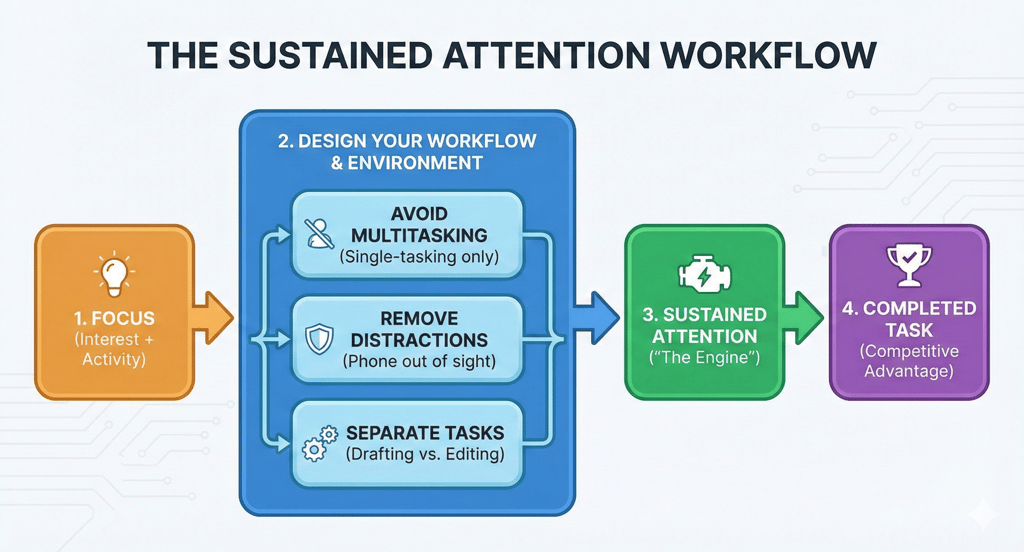
Focused Attention: This is your "spotlight." It is the sharp, intentional interest you are using to read this specific sentence right now.
Sustained Attention: This is your "engine." It is the ability to stay actively engaged as you navigate through a complex task over a long duration.
In 2004, the average attention span on a digital screen was roughly 2.5 minutes. As of 2026, research led by Dr. Gloria Mark has shown this has plummeted to a mere 47 seconds. We are living in a "switch-heavy" reality where our engine stalls before it even warms up.
Why Complexity Demands "The Engine"
Sustained attention isn't just a luxury; it’s a requirement for any meaningful output. Take writing as a stress test. Writing isn't one task; it is a dozen tasks masquerading as one. It involves:
Reflecting and generating ideas.
Distinguishing terms and finding the right words.
Structuring, editing, and writing.
When you are "knee-deep" in these layers, a single text message doesn't just take five seconds of your time—it triggers a switching cost. Studies show it can take upwards of 23 minutes to refocus after a significant distraction. One "scroll binge of hell" doesn't just kill your time; it resets your cognitive momentum to zero.
Redefining Focus
The Oxford Dictionary defines focus as the center of interest or activity.
Interest: The state of wanting to know.
Activity: The condition in which things are being done.
If you lack interest, your focus has no direction. If you lack activity, your focus has no result. To complete anything in life, you need both.
Training for the Long Game
We cannot rely on willpower alone in an environment designed to break us. We must train our minds through intentional workflows:
Separate Your Tasks: Don't try to edit while you draft. One requires a wide lens (sustained), the other a microscope (focused).
Kill the Multitasking Myth: Research consistently shows that multitasking is a biological impossibility; we are simply "task-switching" rapidly and losing IQ points in the process. However, I know many people, myself included, who love listening to music while they work. There's even science backed evidence for classical music to be an enhancer. However, avoid more focus intense activities like podcasts, or TV series as "background" noise" as you work.
Control the Environment: If your phone is in your line of sight, you are already using cognitive energy to not check it. I personally put my phone on DND in another room while I focus.
In an age of 47-second spans, the ability to maintain sustained attention is no longer just a skill—it is a competitive advantage.